Guides
How to scale a recipe for any number of people (without maths at the hob)
Halving for two, doubling for eight: what scales linearly, what doesn't (salt, chilli, pan space), and how to get servings right without hob-side maths.
By the RecipeGPT Team · 3 August 2026 · 7 min read
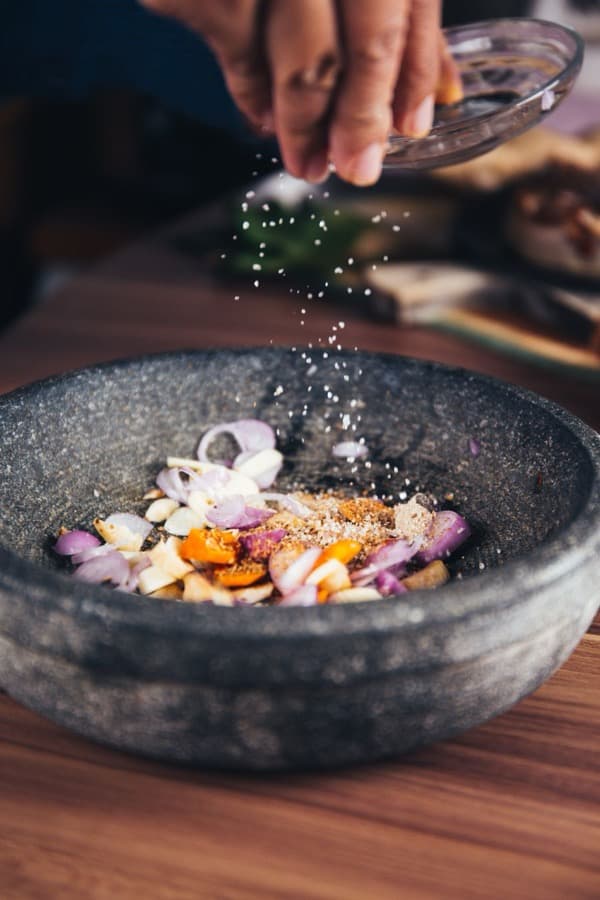
Every recipe is written for a table that isn't yours. It serves four; you're two. It serves two; tonight you're six. The internet's usual answer — “just multiply everything” — is how you end up with a litre of over-salted sauce and a pan so crowded nothing browns.
Scaling is a real technique, and professional kitchens treat it as one: a restaurant recipe is written per portion precisely because the multiplication happens every single service. Home cooks meet the same problem sideways — a family recipe for six cooked for two, a weeknight dish for two stretched across a dinner party — with none of the training. The good news is that most of the technique compresses into knowing which ingredients follow the maths and which don't, plus a handful of equipment rules.
What scales linearly
The bulk of a recipe is honest arithmetic. Pasta, rice, grains, vegetables, meat, fish, stock, tinned tomatoes, coconut milk — the things that make up the body of the dish scale in a straight line. Doubling the people doubles the aubergine. Halve the household, halve the mince. Eggs are the one bulk item that argues: they come in integers, so a halved three-egg frittata becomes a two-egg frittata and nobody minds.
If that were the whole story, a calculator would be a kitchen tool. The interesting parts — and every scaled-dinner disaster — live in the exceptions.
What doesn't scale linearly
- Salt and heat. Season for double and you'll often overshoot — salt, chilli and strong spices need roughly three-quarters of the “correct” scaled amount, then adjusting at the end. Perceived saltiness and heat don't grow in a straight line with quantity, and a big pot reduces differently to a small one. Tasting outranks multiplying, always.
- Aromatics. Garlic, ginger, bay, dried herbs, citrus zest: their flavour builds faster than their quantity. Six cloves in a doubled stew reads like nine, not six. Scale them gently — around 1.5× when doubling — and let the final taste decide.
- Pan space. The silent killer of doubled recipes. Twice the chicken thighs in the same pan doesn't brown, it steams — the meat's moisture has nowhere to go and the pan temperature collapses. Bigger batches need a bigger pan, two pans, or two batches; the recipe's cookware assumptions changed the moment the servings did.
- Liquids in braises and stews. Liquid should cover what it needs to cover, and a wider pot exposes more surface for evaporation. Scale the liquid to the geometry, not the multiplier: add enough to just cover, hold some back, and top up as the simmer tells you.
- Time — sort of. A bigger pot takes longer to come to the boil, a fuller tray roasts a little slower, a doubled braise takes longer to return to a simmer after everything goes in. But a chicken thigh still cooks in chicken-thigh time: individual pieces cook at their own pace provided they have space. Scale the waiting slightly; never scale the safe internal temperature.
- Baking. Cakes and breads are chemistry; scaling them changes tin geometry, bake times, rise behaviour and leavening balance all at once. A doubled cake in a doubled tin is a different cake. Find a version written and tested for your quantity instead of improvising one — bakers publish by tin size for exactly this reason.
Scaling the equipment, not just the ingredients
Most scaled-recipe failures are equipment failures wearing a costume. Going up: a doubled traybake wants two trays with breathing room (and a swap between oven shelves halfway) rather than one crowded tray; a doubled sear wants batches — brown half, rest it on a plate, brown the rest, then reunite everything for the saucy part. Going down: a half recipe in a full-size pan burns its fond and evaporates its sauce, so step down to a smaller pan where the liquid still has depth. The rule of thumb both directions: keep the food's depth in the vessel roughly what the original recipe implied.
Ovens forgive more than hobs — air circulates around trays — which is why traybakes and roasts are the friendliest dishes to scale up, and why sauces and risottos are the friendliest to scale down. If you're stretching a dish for a crowd, lean into the oven's tolerance and pick the traybake variant of whatever you were planning.
The maths nobody wants at 6pm
Even when the rules are clear, the arithmetic isn't fun with a knife in one hand. A recipe for four cooked for six is 1.5× — fine until it meets 340 g of tomatoes (510 g), ¾ tsp of chilli flakes (1.125 tsp, which no spoon measures), and 2½ tbsp of oil (3.75 tbsp — what?). Halving is worse: half of ⅓ cup, half of one egg, half of “a thumb of ginger”. Each conversion is trivial; ten of them mid-prep is exactly the mental load that makes people default to “I'll just make the four portions and eat leftovers forever”.
This is one of the places an AI recipe tool is simply better than a page of text. In RecipeGPT the serving count is a control, not a suggestion: set it anywhere from 1 to 24 and the recipe arrives with quantities, timings and pan sizes already right for that number — the generated plan isn't accepted unless its servings match yours exactly. Quantities come as human-ready amounts in metric and imperial, not as long division (“510 g”, not “1.5 × 340 g”). Change your mind after the recipe exists (“for 6 instead”) and you get a complete fresh version rather than a patched one, so the timings and pan advice stay coherent; repeat adjustments you've made before come back instantly.
It also composes with the rest of the kitchen: paste a recipe link and the author's dish is restructured AND scaled to your table in one move — the two adaptations people do by hand, done together, with the source credited.
Scaling up on purpose: the leftovers strategy
Not all over-catering is a mistake. Doubling deliberately — cook once, eat twice — is the lazy cousin of meal prep and honestly the more sustainable habit: no Sunday marathon, just a ×2 on dishes that reheat with dignity. The good doublers are stews, curries, ragùs, soups, and roasted-veg bases like our quinoa bowl (dress it fresh on day two). The bad doublers are anything crisp, anything seared to order, and most pasta once it's met its sauce. If you're cooking for two, the honest menu split is: scale the saucy things up, and keep the crispy things at exactly the two portions you'll eat tonight.
Frequently asked questions
If I double a recipe, do I double the cooking time?
Almost never. Individual pieces — a thigh, a fillet, a diced carrot — cook in the same time regardless of how many there are, provided they have space. What grows is the waiting around them: bigger pots boil slower, crowded trays roast slower, a doubled stew takes longer to return to a simmer. Add checking time, not blanket time.
Why did my halved recipe come out bland?
Probably the opposite habit: halving the punchy ingredients exactly. Small batches lose proportionally more aroma to the pan and the air, and under-filled pans over-reduce. Season the halved dish to taste at the end — you'll often land closer to two-thirds of the original than half.
Can I scale a cake or bread recipe?
Treat baking as fixed formulas. A different tin changes depth, which changes bake time and texture; leavening doesn't scale cleanly either. The reliable route is a version of the recipe written for the size you want — or bake the original quantity in the original tin and accept gloriously having spare cake.
How do I scale a recipe that says “serves 4–6”?
Pick the number that matches how your table actually eats and treat it as the truth — vague yields are the author hedging about appetite. If you're cooking for big eaters, read “serves 4–6” as 4; for lighter meals or lots of sides, as 6. A tool that asks for an exact serving count removes precisely this ambiguity.
Is it easier to double a recipe or cook it twice?
For sears, fry-ups and anything crisp: cook two batches back-to-back — ten extra minutes, dramatically better texture. For stews, bakes and sauces: double in one properly sized pot. The dividing line is whether browning matters; if it does, batches win.
Set the table size once
Tell RecipeGPT how many you're cooking for — every recipe arrives already scaled, 1 to 24.